 The Boring Project
Is Jobscan Legit? Yes, And The Score Is Guidance
Jobscan holds 4.3 out of 5 from 347 Trustpilot reviews on one of the oldest domains in this market, so is jobscan legit is answered easily; is jobscan worth it depends entirely on what you believe a match score predicts.
The product is real and established
4.3 from 347 reviews
Jobscan's Trustpilot profile shows 4.3 out of 5 from 347 reviews, on a domain carrying an Ahrefs rating of 79 — among the highest of anything in this market.
Three hundred and forty-seven reviews is a solid middle-sized sample. It is not the thousands that the largest resume tools carry, and it is far beyond the handful most of this market runs on: of a hundred tools we checked against their own profiles, 79 had no reviews at all.
A 4.3 across that many people describes a product that works for most buyers with a genuine minority who were disappointed. That is what an honest consumer product looks like at scale.
What it does
Jobscan compares your resume against a job description and returns a match score with suggestions, alongside formatting and parsing checks. The premise is that employer systems read your document before a person does, which is true.
What a match score can and cannot do
The auto-reject myth, corrected
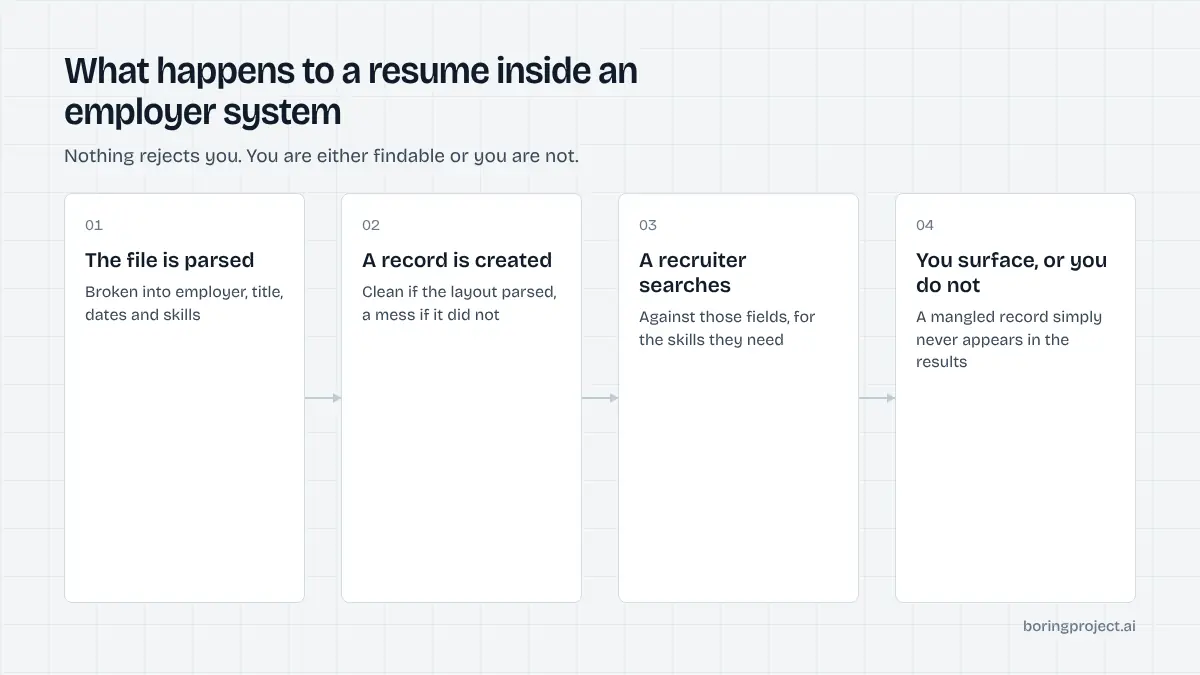
The marketing across this whole category leans on the idea that applicant tracking systems scan resumes and automatically bin the ones that score too low. For most systems that is not what happens, and it is worth being accurate about because it changes what you should fix.
What actually goes wrong is quieter. Your resume is parsed into structured fields — employer, title, dates, skills. If it parses badly, because of a two-column layout, a header table or text inside an image, the resulting record is a mess. Recruiters then search that database for candidates, and a mangled record does not surface. Nothing rejected you. You were simply never found.
That failure mode is real, common, and exactly the thing a parsing check is useful for.
So the parsing half is the valuable half
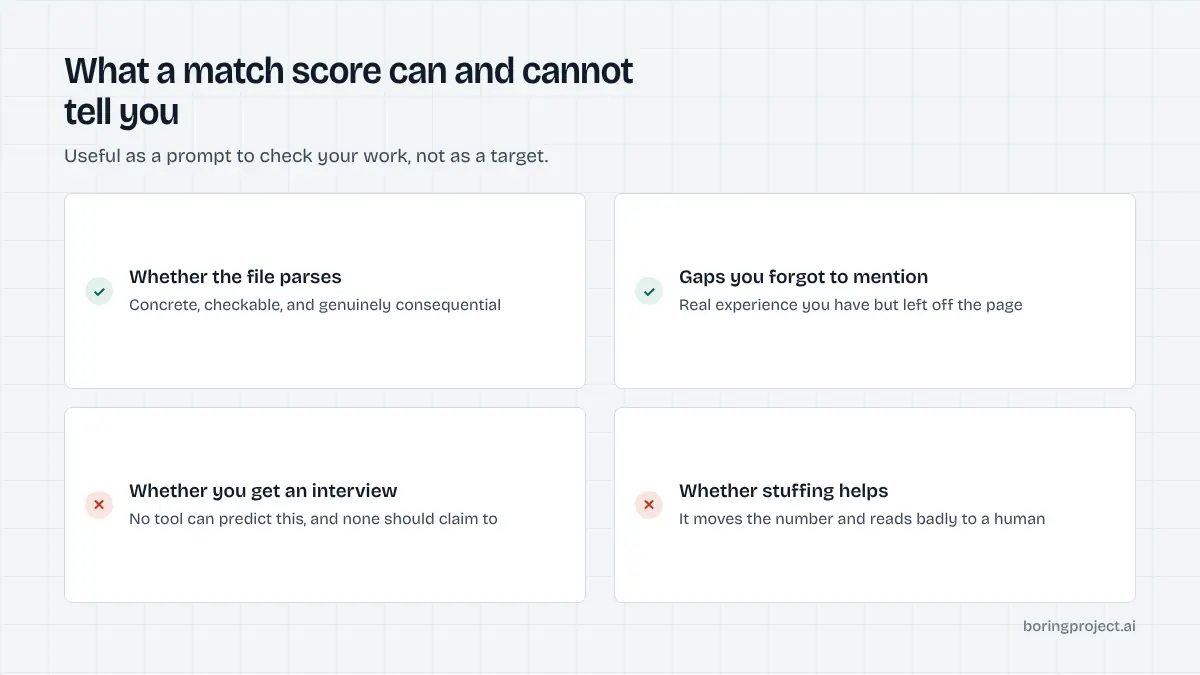
This is where a tool like this earns its money. Confirming that your document converts cleanly into fields is concrete, checkable and genuinely consequential.
The keyword half is softer. Overlap with a job description is a reasonable proxy for whether you have actually addressed the role, and it is not a prediction of anything. Nobody is hired for a match percentage.
Do not chase the number
Closing a genuine gap is worthwhile: if you have done the thing and simply did not mention it, add it. Writing terms into a resume to move a score is counterproductive, because the document still has to read well to the human who opens it, and keyword-stuffed resumes read badly.
Use the score as a prompt to check your own work, not as a target.
Where this leaves the decision
Useful, for a specific job
If you want confidence that your resume survives parsing and covers the language of the roles you are chasing, this is a reasonable purchase with a solid review base behind it.
It does not reduce the application volume
Optimising a resume makes each application slightly better. It does not reduce how many you have to file, and the volume is where the evenings go: a fresh account for every employer system, the same history retyped, the same screening questions again.
That is the half we handle. The Boring Project files applications across Workday, Greenhouse, Lever and 40+ other systems, from $99 a year for 3,600 applications, returning a receipt for each attempt. We sell that, so weigh our view of an adjacent tool accordingly.
Frequently asked questions
Is Jobscan legit?
Yes. It holds 4.3 out of 5 from 347 Trustpilot reviews and runs on one of the most established domains in this market. That is a real product with a real customer base.
Is Jobscan worth it?
It depends what you expect from it. As a check that your resume parses cleanly and covers the language in a job description, it does something genuinely useful. As a predictor of whether you will be interviewed, no tool can deliver that.
Do applicant tracking systems really reject resumes automatically?
Most do not auto-reject on a score. The common failure is subtler: a resume that parses badly produces a messy record, and a record that does not match a recruiter's search never gets surfaced. The outcome resembles rejection without anything rejecting you.
What does a match score actually measure?
Overlap between your resume and the job description, mostly in terms of skills and wording, plus formatting checks. That is a reasonable proxy for whether you have addressed the role, and it is not a hiring prediction.
Should I chase a high match score?
Up to a point. Closing genuine gaps where you have the experience but did not mention it is worth doing. Stuffing a resume with terms to move a number produces a document that reads badly to the human who eventually opens it.
Does Jobscan apply to jobs for you?
Its core product is resume scanning and optimisation against job descriptions. Applying is a separate category, and the forms remain yours unless you add something that submits on your behalf.