 The Boring Project
Is JobCopilot Legit? Yes, And Poorly Reviewed
JobCopilot is a real company selling a real product, so is jobcopilot legit has a straightforward yes attached to it; the harder question, and the one its 1.7 Trustpilot rating raises, is whether is jobcopilot a scam is even the right thing to be asking.
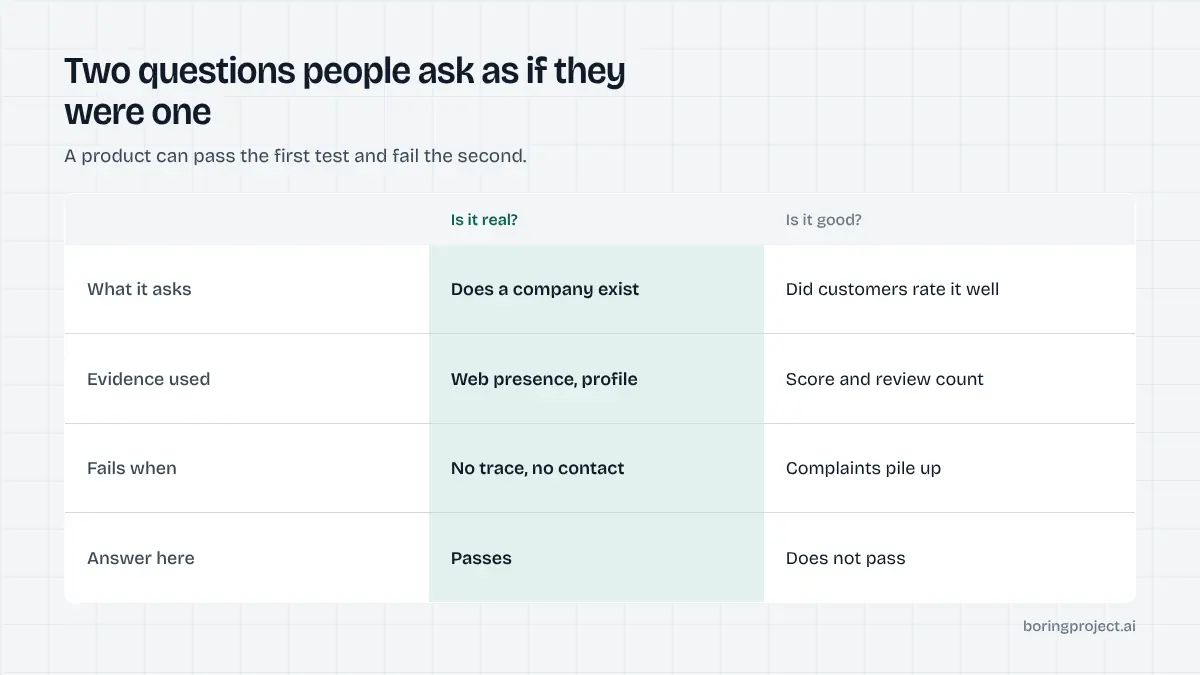
Two questions that get mixed up
The legitimacy question
Legitimate, in the sense people mean when they type this, asks a narrow thing: is there a real company behind this, does it deliver something when you pay, and will you be able to find anyone if it goes wrong.
On that test JobCopilot passes, so anyone asking is jobcopilot legit in the narrow sense can stop worrying about fraud and start weighing the quality record below. It is an established cloud auto-apply agent with a real web presence, a domain carrying an Ahrefs rating of 51, and a claimed public review profile. It is not a storefront that takes a card and disappears. If you are worried about fraud specifically, that worry is not supported by what we can see.
The quality question is where the trouble is
Here is the part no honest page can skip. JobCopilot's Trustpilot profile shows 1.7 out of 5 from roughly 100 reviews. Across the hundred tools in this market we have checked against their primary sources, that is the lowest rating of any product carrying a meaningful sample.
One hundred reviews is not a vendetta or a bad week. It is enough people that a 1.7 is a measurement of something real.
Why the distinction matters to you
If you conflate the two, you make the wrong decision in both directions. You might avoid a perfectly functional product because a forum called it a scam, or you might buy a badly-rated one because somebody confirmed the company is real. "Real company" and "good purchase" are independent, and in this case they point opposite ways.
What the complaints actually allege
Expectation versus delivery
The recurring shape is a gap between what buyers believed the automation would do and what it did: applications that went out but did not match, volume that fell short of what was imagined, output that needed more supervision than the purchase implied.
That is a real complaint and worth weighing. It is not an allegation of theft. Most of the anger in this category comes from this gap, because auto-apply is sold on an outcome nobody can promise and delivered as a mechanical process that can only promise submissions.
Billing friction
The second theme is difficulty getting charges reversed or subscriptions stopped cleanly. This is common across this entire market and it is the most avoidable thing on the list: find the cancellation route before you pay, not after.
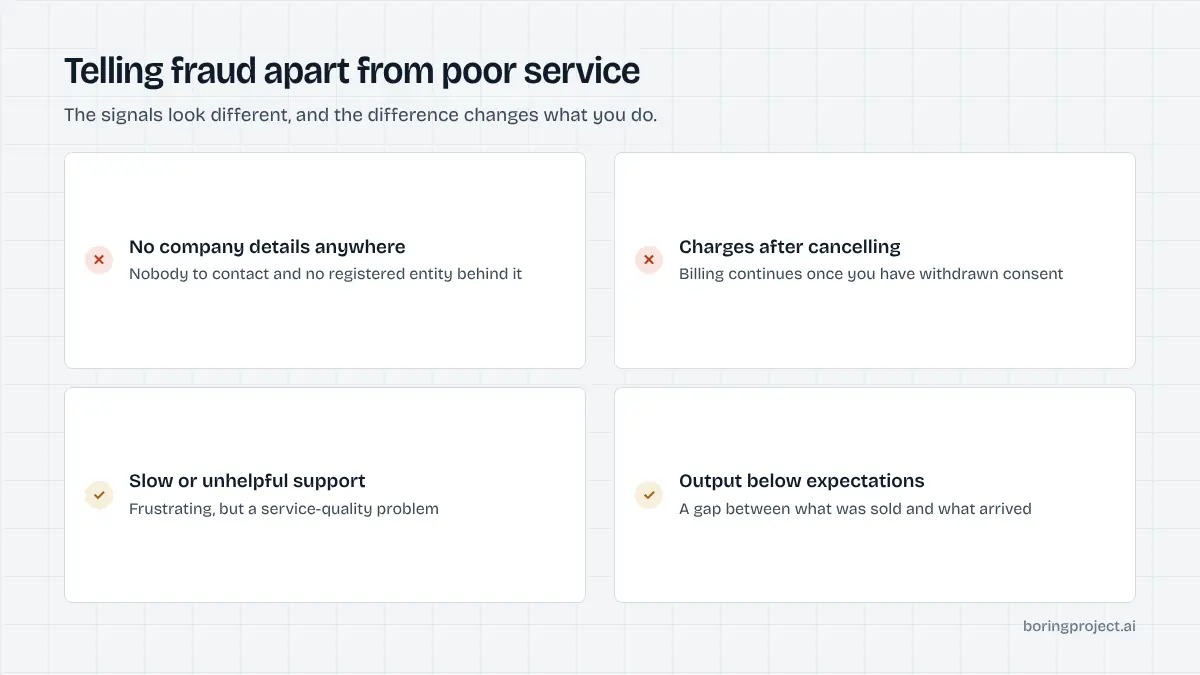
How to tell fraud from bad service
The signals are genuinely different, and worth knowing for any tool you look at. Fraud looks like no company details anywhere, no published refund policy, charges continuing after cancellation, and no reachable human. Poor service looks like slow support, disappointing output, and arguments about what was promised.
JobCopilot's complaint pattern sits in the second column. So the honest answer to is jobcopilot a scam is no, and that is not a defence of the product; it is a correction to the question.
What we would do with this
If you are mid-purchase
A 1.7 across a hundred people is a strong signal to slow down. Not because the company is dangerous, but because a hundred people are telling you the thing they bought did not do what they expected, which is the most relevant data point available about an outcome you cannot verify in advance.
Ask the four questions of anyone, us included
Can you approve each application before it goes out in your name? Is the daily cap yours to set? Are the listings live or aggregated and stale? And do you get a receipt per application showing what was submitted and where?
We sell this, so say it plainly: The Boring Project files applications across Workday, Greenhouse, Lever and 40+ other systems, from $99 a year for 3,600 applications, and returns a receipt for every attempt rather than a count. We would rather you ask us those four questions than take our word about a competitor. Every figure here is read from JobCopilot's own profile and you can check it at the link.
Frequently asked questions
Is JobCopilot legit?
Yes, in the sense that matters legally and practically: it is a real company running a real product that delivers something when you pay. It is not a fake storefront. Its Trustpilot rating of 1.7 out of 5 from around 100 reviews is a separate problem, and a serious one.
Is JobCopilot a scam?
We have seen nothing supporting a fraud claim and we would not make one. What the reviews describe is dissatisfaction with the service, billing friction and unmet expectations, which is a quality complaint rather than a criminal one. Those are different things and conflating them helps nobody.
Why is JobCopilot's rating so low?
At around 100 reviews averaging 1.7, the sample is large enough that this is a pattern rather than a handful of bad days. The complaints centre on the gap between what buyers expected the automation to do and what it did, plus difficulty resolving charges.
Does JobCopilot actually apply to jobs?
It is a cloud auto-apply agent, so yes, that is the product category. The disputes in its reviews are about volume, relevance and quality of the applications rather than about whether anything happens at all.
What should I check before paying for any auto-apply tool?
Whether you can approve each application before it is submitted, whether there is a cap you control, whether a refund route is published, and whether you get a receipt per application. A tool that answers all four is one you can supervise.
Is a 1.7 rating worse than having no reviews?
For a buyer, arguably not. A 1.7 from 100 people tells you something specific and actionable. A blank profile tells you nothing at all, and most of this market is blank. Bad information beats no information when you are deciding where to send your work history.