 The Boring Project
Is AIApply Legit? Well Reviewed, Price Unpublished
AIApply carries 4.3 out of 5 from roughly 2,000 Trustpilot reviews, so is aiapply legit resolves to yes on the evidence; the thing worth knowing before you reach for a card, and the reason is aiapply a scam keeps getting typed, is that we could not find a price published anywhere on the site.
The review evidence is strong
4.3 from about 2,000 people
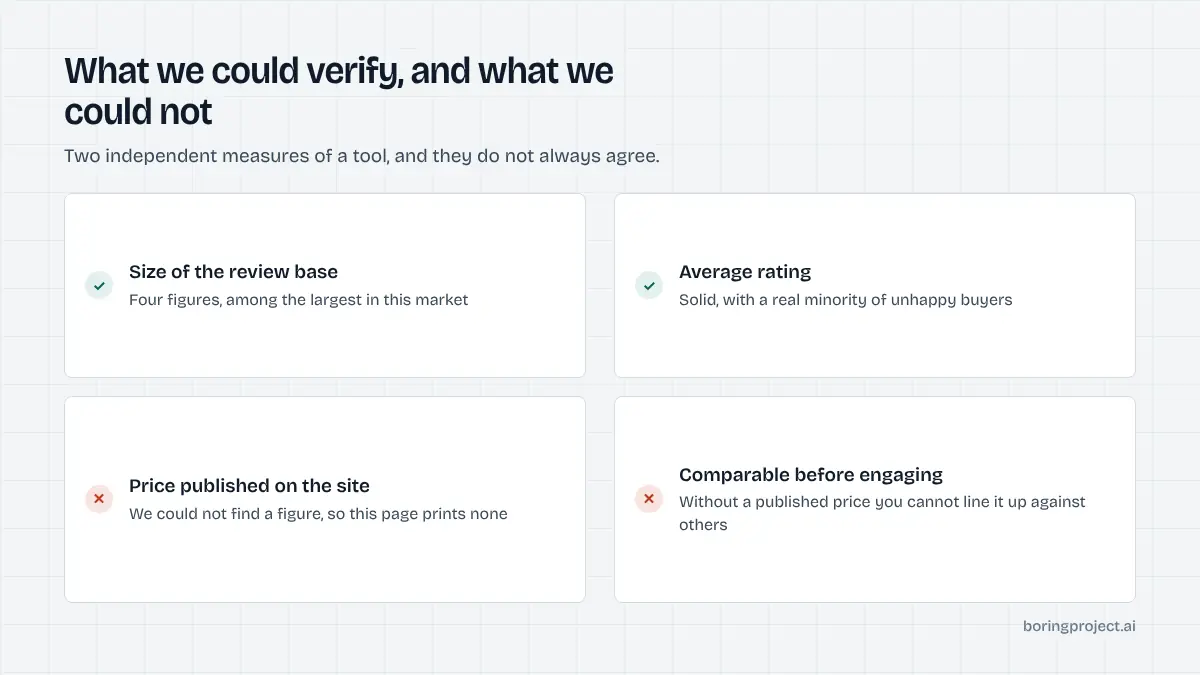
AIApply's Trustpilot profile shows 4.3 out of 5 from roughly 2,000 reviews. Set against the market we surveyed, that is a strong position: of a hundred tools checked against their own profiles, 79 had no reviews at all, and only a handful carry four-figure counts.
So on the narrow question people are actually asking when they type is aiapply legit, whether a real company exists and delivers something, the answer is clearly yes. Two thousand people do not accumulate on a profile for a storefront that takes cards and vanishes.
4.3 is a working score, not a perfect one
Worth reading precisely. A 4.3 across two thousand people means a solid product with a real tail of dissatisfied customers, which is what almost every honest consumer product looks like at that scale. It is not the 4.8 that a smaller sample can produce, and it is far from the 1.7 that the worst-rated tool in this market carries.
Treat it as evidence that the thing works for most people who buy it, with a meaningful minority for whom it did not.
The scam question
It does not survive contact with the evidence. There is a large claimed review profile, a domain carrying an Ahrefs rating of 62, and a long operating history visible on the web. We compete with this product and we will still say that is aiapply a scam has no supporting evidence behind it.
The thing we could not verify
No published price
When we went looking for a figure to print, we could not find pricing published on the site. That is why this page does not quote one.
We are being deliberate about that. Earlier in this research we built an automated price extractor, tested it against hand-verified figures, and found it confidently wrong often enough to be useless: it read salary figures off pages as prices and returned round numbers that were not the real charge. We also kept finding competitor-run comparison articles printing prices for products in this market that do not match the source. Rather than join in, we will say what we know and what we do not.
What unpublished pricing actually costs you
It is not a fraud signal. Quote-based pricing is normal in plenty of legitimate businesses, and some consumer products hold prices back for ordinary commercial reasons.
What it does is move work onto you. You cannot line this product up against three others on a table before engaging. And you lose the chance to think about the number somewhere other than the checkout screen, which is the worst possible place to first encounter a price and the exact spot where the renewal complaints in this market originate.
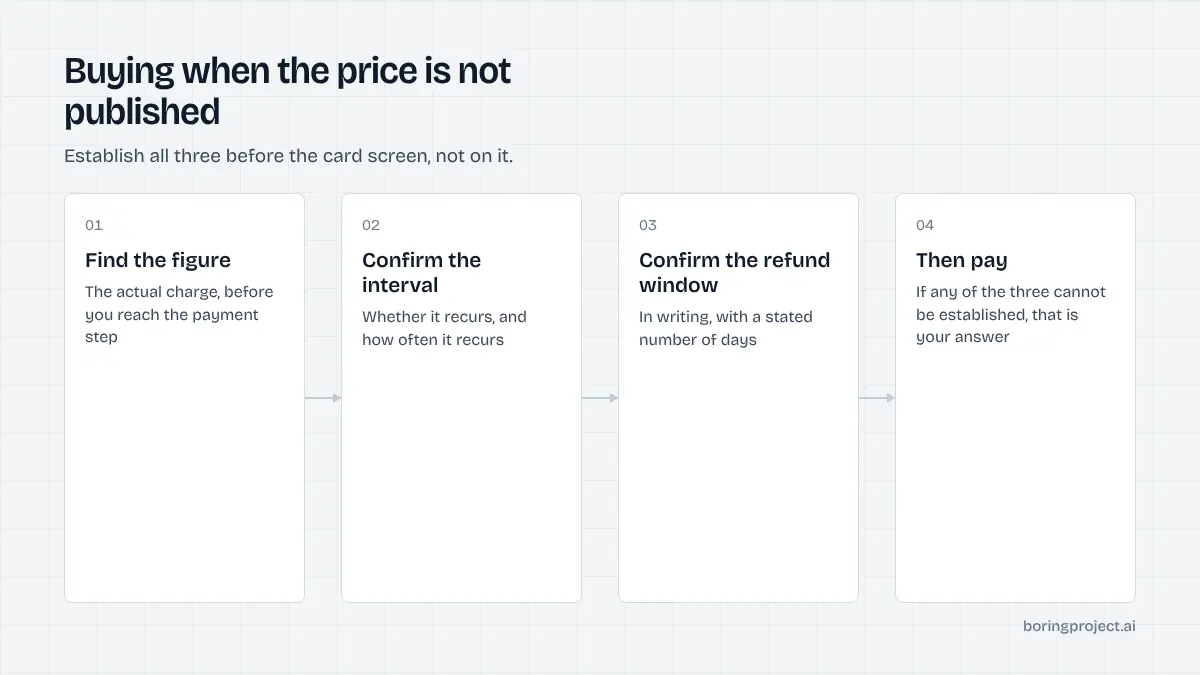
So do the sequence deliberately
Find the actual figure before the card screen rather than on it. Confirm whether that charge recurs, and how often. Confirm the refund window in writing. Then pay. If any of those three cannot be established before payment, that is the answer to whether to proceed.
Where this leaves the decision
Shortlist it, then do the billing diligence
The review base justifies taking this product seriously. The unpublished price means your remaining diligence should go almost entirely into the commercial terms rather than into whether the company is real, because the company plainly is.
The approval question still applies
For anything applying on your behalf, confirm whether submissions wait for your approval or go out and tell you afterwards. That single setting separates a tool you supervise from one you trust blind with your name, and it is independent of how well-reviewed the product is.
Our position, declared
We sell a competing product. The Boring Project files applications across Workday, Greenhouse, Lever and 40+ other systems, from $99 a year for 3,600 applications, with a receipt for every attempt. We publish that figure because we think you should be able to compare before you engage, which is also why the absence of one elsewhere is worth a paragraph rather than an accusation.
Frequently asked questions
Is AIApply legit?
Yes on the evidence available. It holds 4.3 out of 5 from roughly 2,000 Trustpilot reviews, which is one of the larger review bases in this market, and it has a substantial web presence. That is a real company with real customers.
Is AIApply a scam?
Nothing we found supports that. A two-thousand-review base averaging 4.3 is inconsistent with fraud. The question appears in search mostly because people ask it of every AI job tool.
How much does AIApply cost?
We could not find a price published on the site when we looked, which is why this page does not print one. We have caught other comparison articles publishing figures for products across this market that do not match the source, so we will not add a guess to that pile. Get the number from the checkout screen itself.
Is unpublished pricing a red flag?
Not on its own, and plenty of legitimate businesses quote rather than publish. It does shift work onto you: you cannot compare before engaging, and you need to confirm the figure and the billing interval at the moment of purchase rather than in advance.
What does AIApply do?
It is an auto-apply tool with a wider AI toolkit around it, covering application assistance and related job search features. Confirm the current boundary between what it submits automatically and what it drafts for you to send.
What should I confirm before paying?
The actual price on the payment screen, whether the charge recurs and how often, the refund window in writing, and whether applications go out with your approval or without it. Those four cover almost every complaint pattern in this market.