 The Boring Project
7 AIApply Alternatives for Auto Apply
A neutral list of seven AIApply competitors grouped by apply model: agents that match and submit, autofill extensions you supervise, a hybrid human-checked service, a human assistant service, and an API route for builders.
AIApply, as of its site in 2026, describes itself as an AI toolkit for job seekers: resume and cover letter generation, interview preparation and an auto-apply feature that submits applications on your behalf. That combination of document tools plus submission is what most people want to keep when they start shortlisting AIApply alternatives. Our AIApply review covers the product itself.
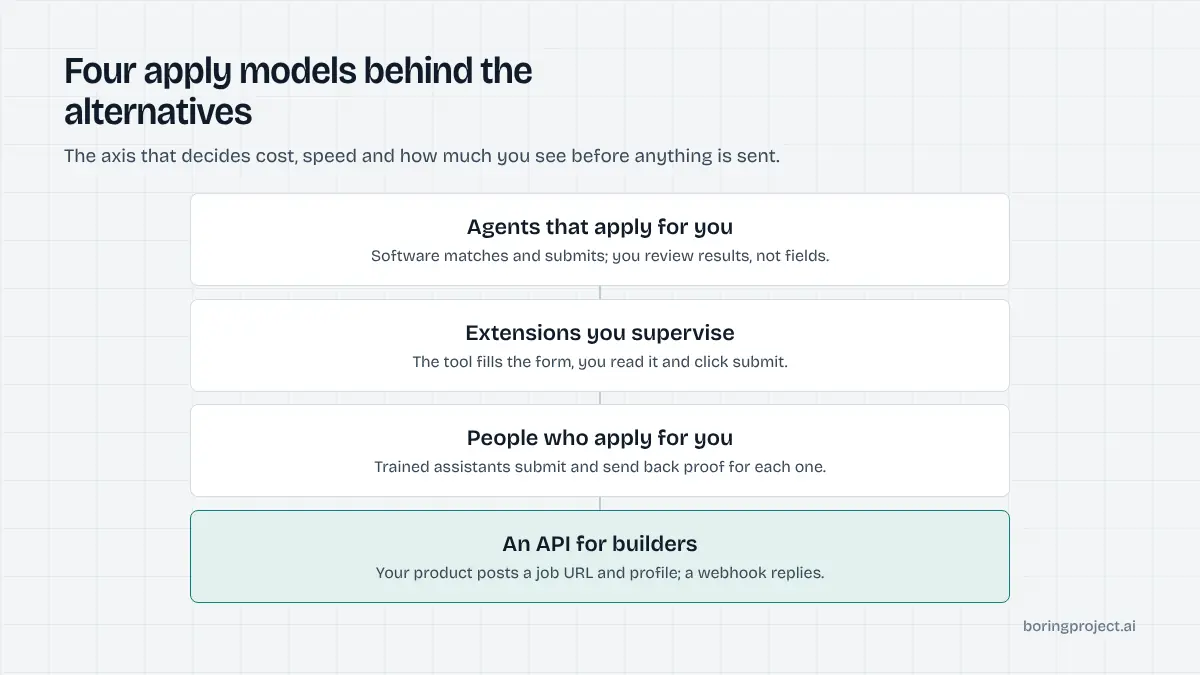
The seven options below are grouped by how the application actually gets submitted. That is the axis that determines cost, speed and how much you see before anything reaches an employer.
Agents that match and submit
These alternatives keep the hands-off part of AIApply, usually with a stronger matching layer.
Jobright
Jobright is built around AI job matching, with a copilot that explains fit, resume tailoring per posting, a browser extension for autofill and an agent that can apply for you. Apply model: cloud auto-submit when the agent is on, autofill otherwise. For AIApply users who want better matching alongside document tools, it is the most direct comparison.
LifeShack
LifeShack describes an AI job search platform that matches you to roles and can apply automatically, with resume tailoring as part of the flow. Apply model: cloud auto-submit. As with any hosted agent, check which application systems it can complete end to end and how it handles screening questions your profile does not answer.
ApplyPass
ApplyPass positions itself as a service that applies for job seekers, historically with a focus on technology roles, using software to tailor and prepare applications and people to review them before they are submitted. Apply model: hybrid, software-prepared and human-checked. It is the alternative for people who want volume but have been burned by purely automated screening answers.
Extensions you supervise
These tools fill the form; you read it and click submit. They are slower per application and safer per application.
Simplify Copilot
Simplify Copilot is a browser extension that autofills application forms across common ATS platforms and keeps a tracker of what you have applied to, with a free tier and a paid upgrade as of its site in 2026. Apply model: autofill, you click submit. It is a minimal, widely used option for people who want speed without delegating the decision.
JobWizard
JobWizard is a Chrome extension that autofills supported ATS forms, drafts answers to custom questions and cover letters, and then returns the form to you for review and submission. Apply model: autofill with a review step. It sells non-renewing 30-day passes alongside a free tier with weekly limits, which suits people who search intensively for short periods.
Careerflow
Careerflow is a broader career platform: resume builder, LinkedIn optimizer, job and networking trackers, mock interviews and an autofill Chrome extension. Apply model: autofill, you click submit. If what you valued in AIApply was the document and preparation tooling rather than the auto-submit, Careerflow covers that ground with manual applying on top.
A human service and the API route
The last consumer option replaces software with people, and the final section is for companies rather than individuals.
Scale.jobs
Scale.jobs is a human application service. You choose the roles, trained assistants submit the applications within roughly a day, and you receive a proof screenshot for each one, with AI used upstream to tailor resumes and cover letters. Apply model: human service. According to its site it can apply through any ATS or portal, and a set of free AI tools sits alongside the paid service.
For builders: use an API
If you are a job board, staffing agency, reverse recruiter or career platform, consumer tools are not the right comparison. They are designed for one candidate with one profile and one browser. You need the submission step as a service your own product can call.
A job application API accepts a job URL and a candidate profile, fills and submits the employer's ATS form across Workday, Greenhouse, Lever, iCIMS, Taleo, SmartRecruiters, Ashby, Workable and more than 40 systems in total, and returns a webhook with a status of submitted, needs_input or failed plus a screenshot receipt. Candidate consent is required on every application, screening answers are never fabricated, and per-employer rate limits apply. Pricing is per successful application. The API documentation covers the request format and webhook payload.
Choosing a row before a tool
| Category | Examples here | Who submits | Best when |
|---|---|---|---|
| Matching agent | Jobright, LifeShack | Software | You want matching plus hands-off applying |
| Hybrid | ApplyPass | Software, human-checked | You want volume with a safety check |
| Autofill extension | Simplify Copilot, JobWizard, Careerflow | You | You want to see every field |
| Human service | Scale.jobs | People | Portals are unusual or you want delegation |
| API | Job application API | Your product | You serve many candidates |
Most regret in this category comes from choosing a tool in the wrong row. Decide how much you want to see before submission, then compare within that row on ATS coverage, screening-question handling and pricing shape.
If you are leaving AIApply specifically because of its document tools, note that Jobright, Careerflow and JobWizard all include resume or cover letter generation, so you do not have to give that up to change apply model. If you are leaving because of how applications were submitted, the row choice matters more than any individual feature list.
Frequently asked questions
What is AIApply, and what makes something an alternative?
AIApply describes itself as an AI job search toolkit with resume and cover letter generation, interview preparation and an auto-apply feature that submits applications for you. An alternative is any tool that covers the submission problem, whether through a hosted agent, a browser extension you supervise, a human or human-checked service, or an API for companies building their own product.
Which AIApply alternatives also tailor documents and apply?
Jobright combines AI job matching and resume tailoring with an applying agent and an autofill extension. LifeShack pairs matching with automated applying. ApplyPass tailors applications and submits them with human review for technology roles. Each covers both the document and the submission side, which is the combination AIApply users usually want to keep.
Are there AIApply competitors that keep me in control of submission?
Yes. Simplify Copilot, JobWizard and Careerflow are all browser extensions that autofill application forms on pages you open and leave the final click to you. They give up the hands-off convenience in exchange for seeing every field before it goes out, which matters most on roles with detailed screening questions.
What is the human-run alternative in this list?
Scale.jobs uses human assistants to submit applications you choose, with a proof screenshot for each and a turnaround of roughly a day. ApplyPass is a hybrid, using software to prepare applications and people to check them before submission. Both cost more per application than pure software but reduce the risk of bad automated answers.
Why should a company use an API rather than one of these tools?
Every tool here is built for one job seeker with one profile. A job board, staffing agency or career platform that submits for many candidates needs programmatic access, consent recorded per application, a status webhook and a receipt for each submission, with its own product owning the interface. A job application API provides that as infrastructure.
How do I evaluate these alternatives without relying on marketing claims?
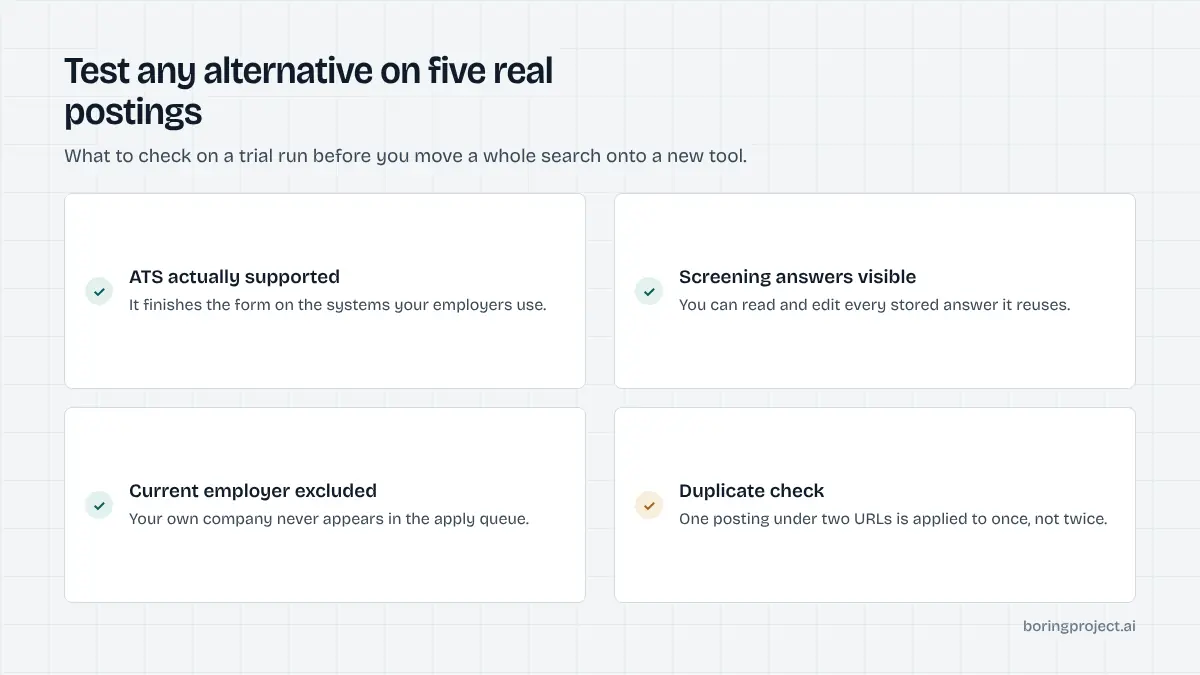
Run each shortlisted tool on five real postings from employers you want. Confirm ATS support, check whether screening answers are shown before submission, test how your current employer and duplicate postings are handled, and look at the record you receive afterwards. Published interview rates and user counts are company figures and should be weighed as such.
Next step
Job seekers should pick the row that matches how much they want to see before submission and trial two tools from it on real postings. Companies that need applications submitted for many candidates should start with our job application API and run a few test submissions against a live ATS.